

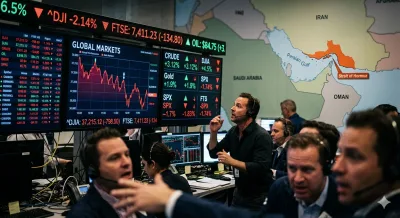
Indian stock markets, including the BSE Sensex and NSE Nifty, are on high alert as a 48-hour deadline set by US President Donald Trump for Iran approaches. Investors are carefully monitoring the situation, weighing both the risks of potential military escalation and the possibility of a diplomatic resolution by Monday.
Geopolitical Tensions Drive Market Uncertainty
President Trump's recent social media posts and statements have significantly heightened geopolitical tensions in West Asia. He issued stark warnings, indicating potential strikes on key Iranian infrastructure such as power plants and bridges, stating, "Tuesday will be Power Plant Day, and Bridge Day, all wrapped up in one, in Iran. There will be nothing like it!!!" This aggressive rhetoric has contributed to market uncertainty and kept investors guessing about the region's stability.
Amid these warnings, Trump also reportedly told Fox News that a deal with Iran was possible by Monday, suggesting ongoing negotiations. This mixed messaging has created a volatile environment for global markets.
Global Energy Supply Concerns and Crude Oil Prices
A major concern for global markets stems from Trump's demand for Iran to open the Strait of Hormuz, a crucial choke point for international oil shipments. He warned that failure to comply could lead to Iranians "living in hell." Rising risks around this vital waterway directly threaten global energy supplies, pushing crude oil prices higher and keeping markets on edge.
Ponmudi R, CEO at Enrich Money, noted that "the ongoing geopolitical tension in West Asia continues to act as a major overhang, and the latest developments have added fresh uncertainty after Donald Trump signaled possible strikes on key Iranian infrastructure." Hariprasad K, a SEBI-registered Research Analyst, added that "Comments from US President Donald Trump indicating potential escalation if key supply routes are not restored have kept risk appetite in check. This continues to keep crude oil and global uncertainty as dominant drivers for markets."
Market Reactions and Expert Outlook
Early trading on Monday showed mixed signals. Gift Nifty was down 89.50 points, or 0.40 percent, at 22,615. Conversely, Asian markets such as Japan's Nikkei 225 and South Korea's Kospi were trading 0.9 percent higher each. These fluctuations underscore the market's sensitivity to the evolving situation.
An unverified Reuters report, which Business Today could not independently confirm, cited a spokesperson for the unified command of Iranian armed forces claiming two US C-130 military transport planes and two Black Hawk helicopters were destroyed during a US rescue operation. Such reports, even if unconfirmed, add to the atmosphere of heightened tension.
Meanwhile, OPEC-plus members agreed to a modest increase of 206,000 barrels per day in oil output quotas for May. However, Reuters reported that this rise might largely exist on paper, as key members face challenges in raising production due to the ongoing US-Israeli conflict with Iran.
Market expert Sandip Sabharwal cautioned against panic selling, drawing parallels to the COVID-19 market downturn. "People who sold during the Covid selloff regretted in the next 6 months and some never got the guts to invest higher. The same will happen to those panicking now," he posted on X.